
Insulated Glass Replacement: Fix the Glass, Not the Whole Window
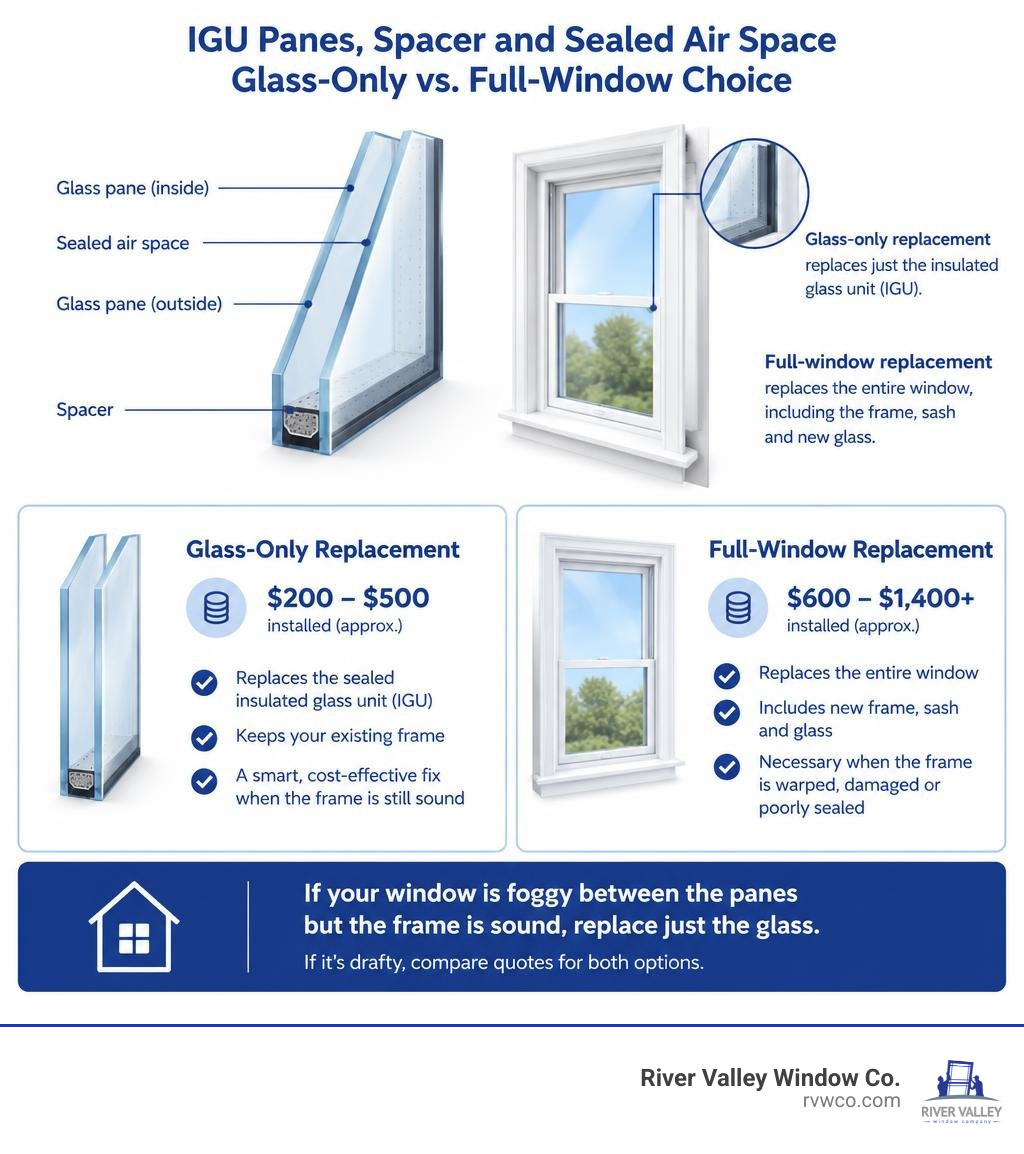
If a double-pane window is foggy between the panes but its frame is sound, you can usually replace just the sealed glass unit. Have a glazier check the frame, measure the unit, and match its thickness, glass type, and coating before ordering. Glass-only replacement often costs about $200-$500 installed, compared with $600-$1,400 or more for a full window.
If the window is drafty because the frame is warped, damaged, or poorly sealed, new glass alone will not fix the draft. In that case, compare quotes for both options before spending money.
Must-know insulated glass replacement terms:
Understanding Insulated Glass Units and Identifying Seal Failure
When you look through a modern window, you are rarely looking through a single sheet of glass. Most homes rely on an Insulated Glass Unit (IGU)—a sealed system built to resist heat flow, quiet outdoor noise, and keep interior spaces comfortable.

However, like any building component exposed to intense weather, these units do not last forever. Recognizing the key signs it’s time for window replacement or glass repair begins with understanding how an IGU is constructed and why its boundary seals eventually break down.
What Is an IGU and Why Do Seals Fail?
An IGU consists of two or three lites of glass held apart by a perimeter spacer bar. The hollow interior of the spacer bar is packed with desiccant beads—tiny porous crystals designed to absorb any ambient moisture trapped inside the air space during manufacturing. The entire perimeter is then bound by a primary seal (often polyisobutylene) and a robust secondary seal (such as silicone or polyurethane) to form an airtight, watertight barrier. The cavity is filled with dry air or an inert gas like argon to slow heat conduction.
Why do these industrial seals fail?
- Thermal Expansion and Contraction: Daily exposure to the sun bakes the exterior pane, causing the glass and frame to expand. At night, the assembly contracts. This continuous cycle, known as solar pumping, puts relentless mechanical tension on the perimeter seal.
- Atmospheric and Elevation Pressure: Changes in elevation and barometric swings cause the sealed unit to expand like a balloon or bow inward. Every 1,000 feet of elevation gain drops atmospheric pressure by roughly 0.5 PSI, placing continuous outward force on the bond.
- Desiccant Saturation: Once a microscopic pathway opens in the seal, outside humidity creeps into the cavity. The desiccant absorbs this incoming vapor until it reaches full capacity. Once saturated, moisture hangs freely in the air gap.
Recognizing Permanent Fogging, Haze, and Condensation
Homeowners often ask how to distinguish surface condensation from true seal failure. If you run your finger over the wet glass inside or outside your home and the moisture wipes away, your seal is fine—you are simply seeing interior humidity meeting a cold surface.
When a seal fails, you will notice:
- Un-wipeable Fog: Moisture droplets, mist, or cloudiness trapped between the two panes that cannot be touched or cleaned from either side.
- Milky Haze and Mineral Stains: Over time, trapped moisture evaporates and condenses repeatedly, leaving mineral residue and etching the inner glass surfaces permanently.
- Thermal Bridging: The loss of inert gas allows heat to transfer freely across the panes, making the window feel noticeably hotter in summer and colder in winter.
When comparing your options, understanding single vs double pane windows makes it clear that a compromised double-pane unit loses virtually all of its engineered thermal insulation, behaving much closer to an inefficient single pane of glass.
Glass-Only IGU Swap vs. Full Window Replacement: The Budget Framework
Choosing between replacing just the insulated glass unit or installing an entirely new window comes down to structural integrity, long-term costs, and overall window condition.
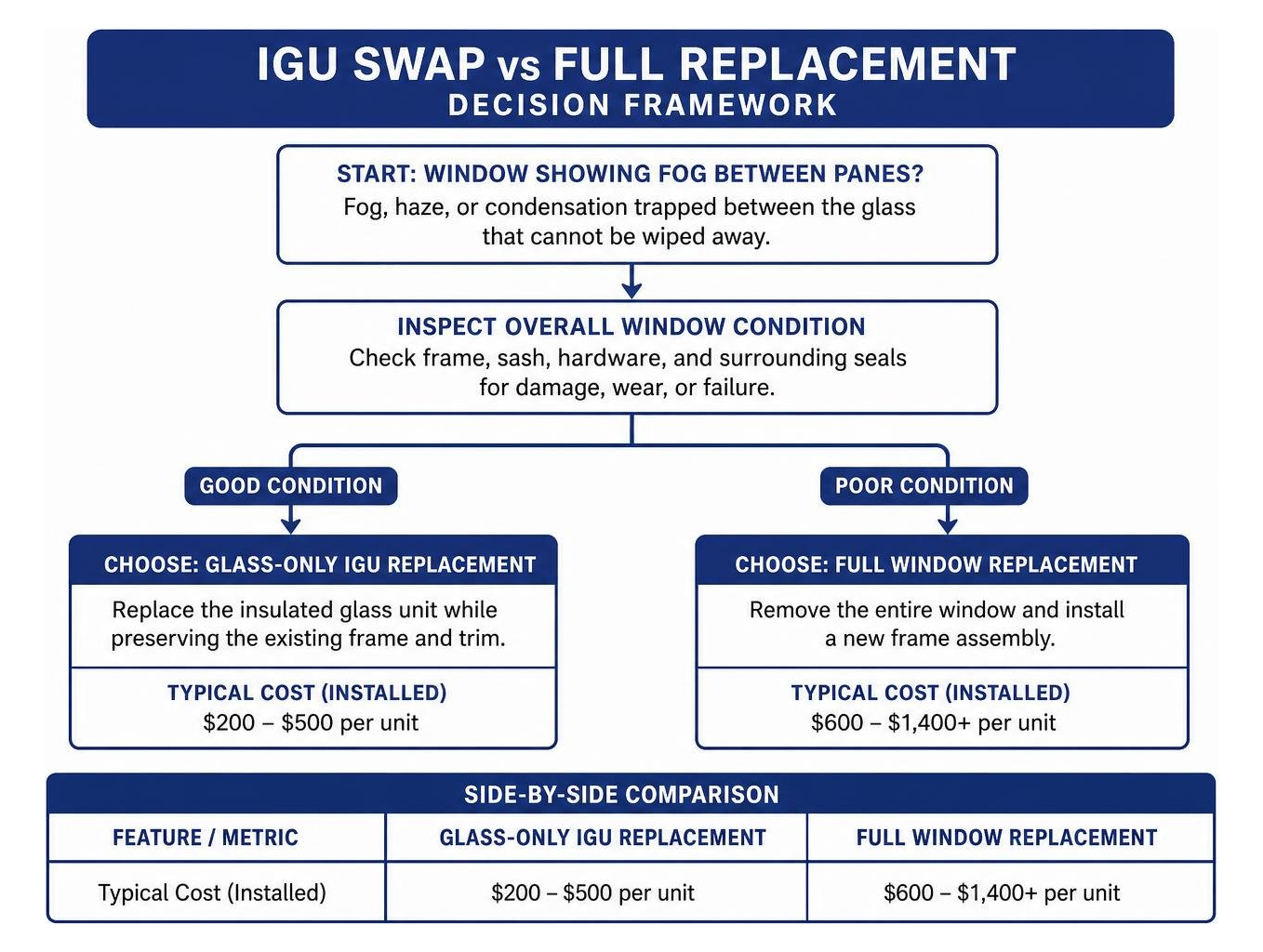
A glass-only swap replaces the sealed glass assembly while preserving your existing sash, master frame, and interior trim. A full replacement removes the entire window frame down to the rough opening or retrofits a brand-new frame assembly into the opening.
| Feature / Metric | Glass-Only IGU Replacement | Full Window Replacement |
|---|---|---|
| Typical Cost (Installed) | $200 – $500 per unit | $600 – $1,400+ per unit |
| Average Service Life | 15 – 20 years | 25 – 30+ years |
| Installation Time | 45 – 90 minutes per sash | 2 – 4 hours per window |
| Impact on Surrounding Trim | Zero disruption to interior/exterior trim | Requires touching exterior trim/casing |
| Solves Frame Rot/Drafts? | No | Yes |
| Cost per Year (Solid Frame) | ~$23/year ($350 over 15 years) | ~$36/year ($900 over 25 years) |
When to Choose Glass-Only Insulated Glass Replacement
If your window frames are structurally sound, square, and operate smoothly, a glass-only replacement is the most cost-effective path. It delivers identical clarity and restores original factory thermal performance without the expense of framing, trim adjustments, and dry-wall work.
Glass-only replacement is ideal when:
- The vinyl, fiberglass, or finished aluminum frame shows no physical warping, cracking, or rot.
- Only one or two windows in a home have fogged due to isolated seal failure.
- You want to maximize your repair budget without altering your home’s exterior aesthetic.
- You are evaluating your local window replacement options and need a fast, non-invasive solution.
When Frame Deterioration Demands Full Replacement
A new IGU cannot fix a failing frame. If you put a $350 IGU into a rotting or heavily warped frame that fails in five years, your real cost is $70 per year—nearly double the amortized cost of doing a full replacement from day one.
Full window replacement is the better investment when:
- Wood Rot or Structural Decay: Moisture has penetrated the sash or sill, weakening the structural support.
- Severe Air Infiltration: The window frame itself is out of square, allowing drafts around the sash edges regardless of glass quality.
- Failed Hardware: Balances, cranks, or locking mechanisms are broken and replacement parts are obsolete.
- Aging Single-Pane Units: If you have spent significant money repairing older units, understanding the real cost of changing house windows reveals that full upgrades pay for themselves far quicker. Reviewing our analysis on replacement window ROI can help you determine if a complete upgrade aligns with your financial goals.
Key Specifications and Measurement for Insulated Glass Replacement
Insulated glass units are custom-manufactured to exact dimensions; they cannot be cut down on-site. Precision measurement is critical to avoid ordering an IGU that does not fit into the sash channel.

Measuring Your Existing Unit Accurately
Glaziers use a three-point measurement system to account for frame settling or out-of-square openings.
- Measure Width: Measure the horizontal distance inside the sash pocket at three points: the top, the middle, and the bottom. Record the smallest measurement.
- Measure Height: Measure the vertical distance from the top sash channel to the bottom sill channel at three points: left, center, and right. Record the smallest measurement.
- Deduct for Clearance: Standard fabrication requires an industry-standard deduction (typically 1/8 inch off both overall width and height) so the unit sits with adequate clearance on setting blocks.
- Determine Overall Thickness (OT): Measure the total thickness of the assembly (outer glass pane + spacer width + inner glass pane). Common residential overall thicknesses are 1/2 inch, 5/8 inch, 3/4 inch, or 1 inch.
Specifying Glass Types, Low-E Coatings, Spacers, and Gas Fills
When ordering an IGU, every component must be specified to match local building codes and thermal requirements:
- Glass Makeup: Standard residential glass uses 1/8-inch (3mm) or 5/32-inch (4mm) annealed float glass. Windows close to doors, stairs, or less than 18 inches from the floor require tempered safety glass by code.
- Low-E Coatings: Low-emissivity coatings reflect infrared heat while letting visible light pass. In warm climates, applying Low-E to surface #2 (inside of the outer pane) blocks incoming solar radiation. In cold zones, surface #3 reflects interior room heat back inside.
- Warm-Edge Spacers: Older aluminum spacer bars act as thermal bridges. Modern composite, stainless steel, or butyl-based warm-edge spacers reduce perimeter heat loss and resist condensation.
- Inert Gas Fills: Argon gas is denser than air, slowing convective heat transfer within the cavity and boosting overall insulation. Learning how energy efficient windows save substantial money will help you choose the right glass package.
Step-by-Step Guide to the Installation and Ordering Process
Installing a replacement IGU requires patience, clean workspace preparation, and careful handling of heavy glass panes.
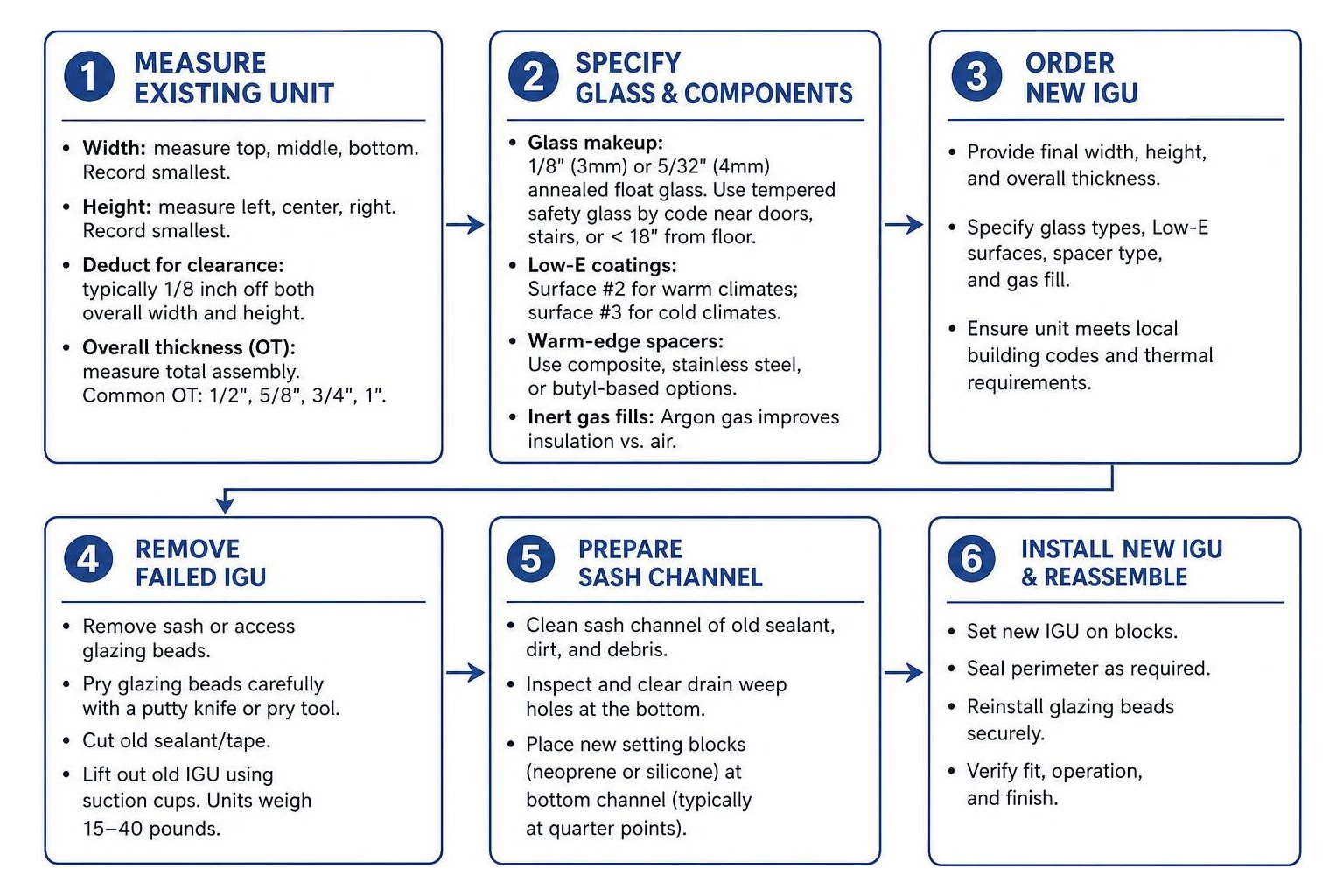
- Remove the Sash or Access Glazing Beads: On operable windows, remove the sash and lay it flat on a padded work table. On fixed picture windows, work directly from the interior or exterior depending on bead placement.
- Pry the Glazing Beads: Using a flexible putty knife or specialized pry tool, carefully unclip the vinyl or aluminum glazing stops without bending or cracking them.
- Cut Old Sealant and Extract Unit: Cut through old butyl tape or silicone adhesive along the glass edge. Carefully lift the old IGU out using suction cups. (Even a failed unit weighs 15 to 40 pounds!).
- Clean the Sash Channel: Scrape away old sealant, dirt, and debris. Inspect the drain weep holes at the bottom of the sash to ensure water drains freely.
- Place New Setting Blocks: Position neoprene or silicone setting blocks at the bottom channel (typically at the quarter points) to elevate the glass and keep the seal out of standing moisture.
- Set and Seal the Replacement Unit: Place the new IGU squarely on the setting blocks, center it in the opening, apply fresh glazing tape or neutral-cure silicone, and snap the glazing beads back into position. For comprehensive details on full installation methods, review our painless window installation best practices.
Sourcing, Turnaround Times, and Special Applications
Standard rectangular IGUs fabricated with clear or Low-E glass generally take 5 to 10 business days to manufacture. Total turnaround time—from initial measurement to final installation—typically spans 1 to 3 weeks.
Custom applications require longer lead times (typically 3 to 4 weeks):
- Non-standard geometric shapes (arches, trapezoids, circles).
- Internal decorative grids (muntin bars between the panes).
- High-performance laminated glass or custom tints.
Understanding Warranties and Glass Breakage Coverage for Insulated Glass Replacement
When investing in replacement glass or full window units, understanding manufacturer warranty protections is essential. At River Valley Window Co., we specialize in high-performance products that provide long-term peace of mind.
For Milgard product lines, warranty coverage follows a tiered structure:
- Standard Limited Lifetime Warranty: Coverage varies depending on whether the project is new construction or replacement scope, as well as property occupancy. If the property is transferred after purchase, the warranty converts to a 10-year parts-only limited warranty calculated from the original manufacture date, including 10-year hardware coverage and product-specific finish and weatherstripping limitations.
- Paid Full Lifetime Warranty Upgrade: This upgrade remains valid for the natural lifetime of the original consumer owner, is non-transferable, and covers both parts and labor. It includes full comprehensive glass breakage coverage for Tuscany® V400 and V450 series, while requiring glass breakage as an added upgrade option for Trinsic™ V300 series.
- Specific Warranty Limits: Both warranty tiers maintain specific shorter limitations, including a 10-year limit on insulated glass unit delamination, internal blind defects, and peeling or fading exterior finishes, alongside a 1-year limit on weatherstripping, window screens, and corrosion on stainless steel hardware.
Frequently Asked Questions About Insulated Glass Replacement
How much does it cost to replace an insulated glass unit?
A professional glass-only IGU replacement typically costs between $200 and $500 installed for standard residential sizes. The glass and custom fabrication usually account for $60 to $180 of that total, with the remainder covering professional labor, travel, and disposal. Larger picture windows, tempered safety glass, and custom Low-E packages can push the installed price higher.
Can you replace the insulated glass in discontinued or impact-rated windows?
Yes. Because replacement IGUs are custom-built to exact height, width, and thickness specifications, they can be fabricated for almost any existing window frame, even if the original window manufacturer has gone out of business. For impact-rated windows, replacement units can be fabricated with matching laminated glass makeups to preserve the structural safety rating of the opening.
How long does the entire replacement process take from measurement to install?
The standard turnaround time from initial measurement to completed installation is usually 1 to 3 weeks. Standard fabrication takes 5 to 10 business days, while custom shapes, tempered-laminated combos, or internal decorative grids may take 3 to 4 weeks. Once the new glass arrives, the on-site physical installation takes only 45 to 90 minutes per sash.
Conclusion
A foggy window does not mean you have to endure the expense and disruption of tearing out an entire window frame. If your frames are structurally sound, an insulated glass replacement delivers restored optical clarity, original energy efficiency, and reliable acoustic insulation at roughly half the price of a full window replacement.
At River Valley Window Co., we specialize in helping homeowners across Northwestern Arizona find the right balance between cost, performance, and long-term durability. Whether you need a precision glass swap or a complete whole-house window upgrade, our team provides fast, non-invasive installations backed by industry-leading warranties.
Explore our complete range of professional window replacement and glass services or contact our team today to schedule an on-site evaluation!