

What Does It Cost to Replace Windows in a House?
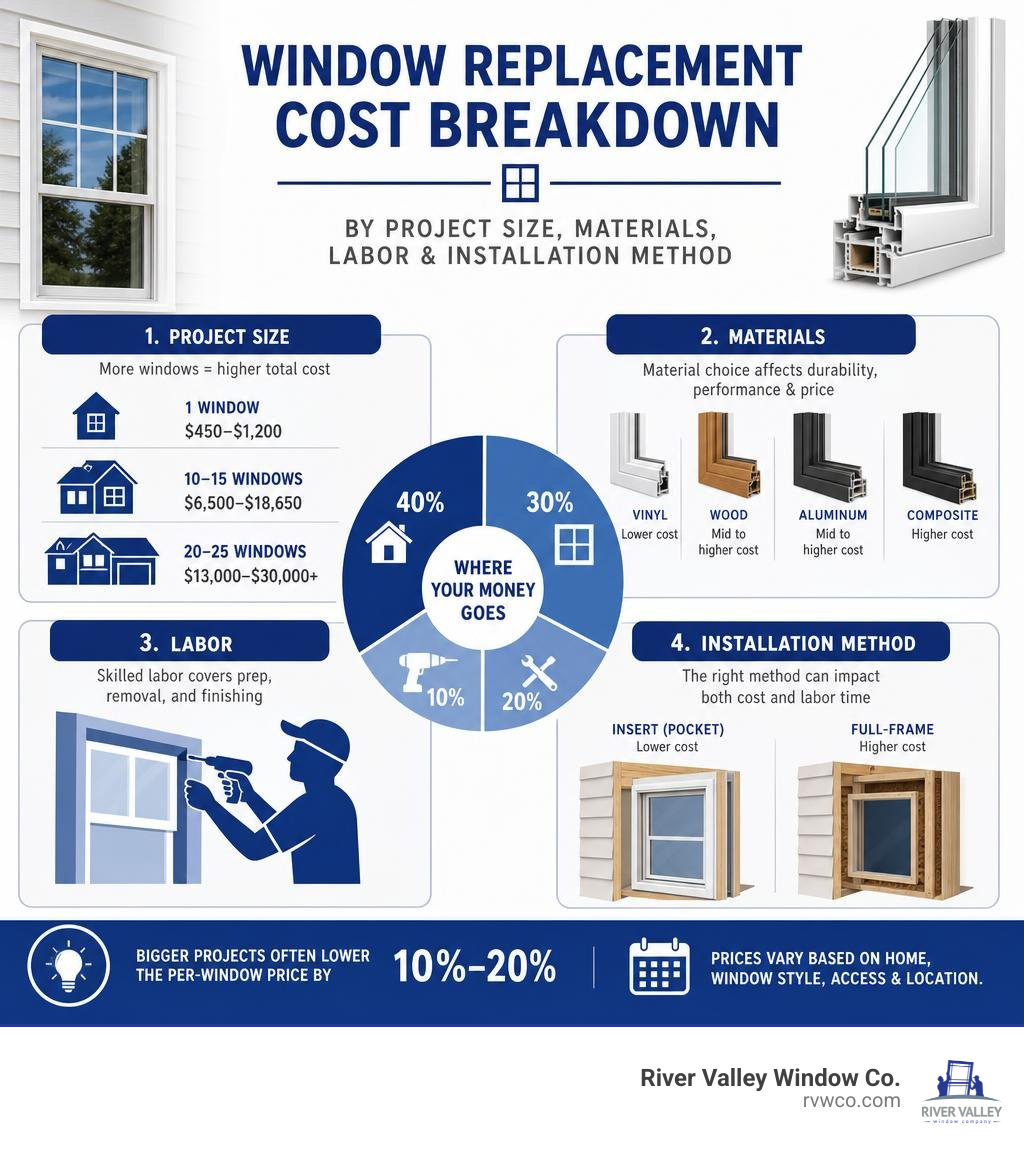
In 2026, the cost to replace windows in a house is usually $450 to $1,200 per window installed, with a national average near $750 per window. For a typical home with 10 to 15 windows, plan on roughly $6,500 to $18,650. A 20- to 25-window project, premium materials, full-frame installation, or second-story access can raise the total well beyond that range.
For a fast starting estimate:
| Project scope | Typical installed cost |
|---|---|
| One standard replacement window | $450-$1,200 |
| 10-15 windows | $6,500-$18,650 |
| 20-25 windows | $13,000-$30,000+ |
The biggest price drivers are the frame material, glass package, window size and style, and whether your existing frames can accept lower-cost insert replacements. In Northwestern Arizona, heat control matters too: energy-efficient glass can cost more upfront but may improve comfort in sunny rooms and reduce strain on your cooling system.
Replacing all windows together can often lower the per-window price by 10% to 20% compared with doing the same work in separate phases. The right approach still depends on your budget and whether a few windows are already leaking, fogged, warped, or difficult to operate.
This guide breaks down the numbers so you can compare estimates, choose a practical window package, and plan a project with fewer surprises.
Cost to replace windows in house further reading:
Average Cost to Replace Windows in House by Project Size
Estimating home window replacement comes down to volume, labor logistics, and structural condition. When tackling home improvements, How to budget for window replacement for your home requires viewing both per-unit figures and aggregate scale. National averages provide a helpful baseline, starting between $632 and $967 per opening across baseline installations, but project scope sets the final bottom line.
Single Window Replacement Baseline Pricing
When addressing a solitary damaged, drafty, or broken opening, homeowners face baseline costs between $450 and $1,200 for a standard installed unit. A straightforward vinyl double-hung or single-sliding window often lands near the $600 to $750 mark.
Replacing one window carries a higher per-unit installation expense due to minimum labor charges, mobilization, and travel fees. Unpacking the Don’t get pane-fully ripped off the real cost of changing house windows reveals that single-opening jobs lack the purchasing power of larger contracts. Specialized openings—such as large picture windows, casements, or custom geometric shapes—quickly scale from $800 to $1,500+ installed.
Whole-Home Cost to Replace Windows in House: 10 to 25 Units
Full-home renovations present different financial dynamics. For typical single-story ranch homes with 10 to 15 windows, installed totals average $6,500 to $18,650. Moving up to larger properties, such as a 2,500-square-foot two-story layout with 20 to 25 openings, costs span $13,000 to $30,000 or more.
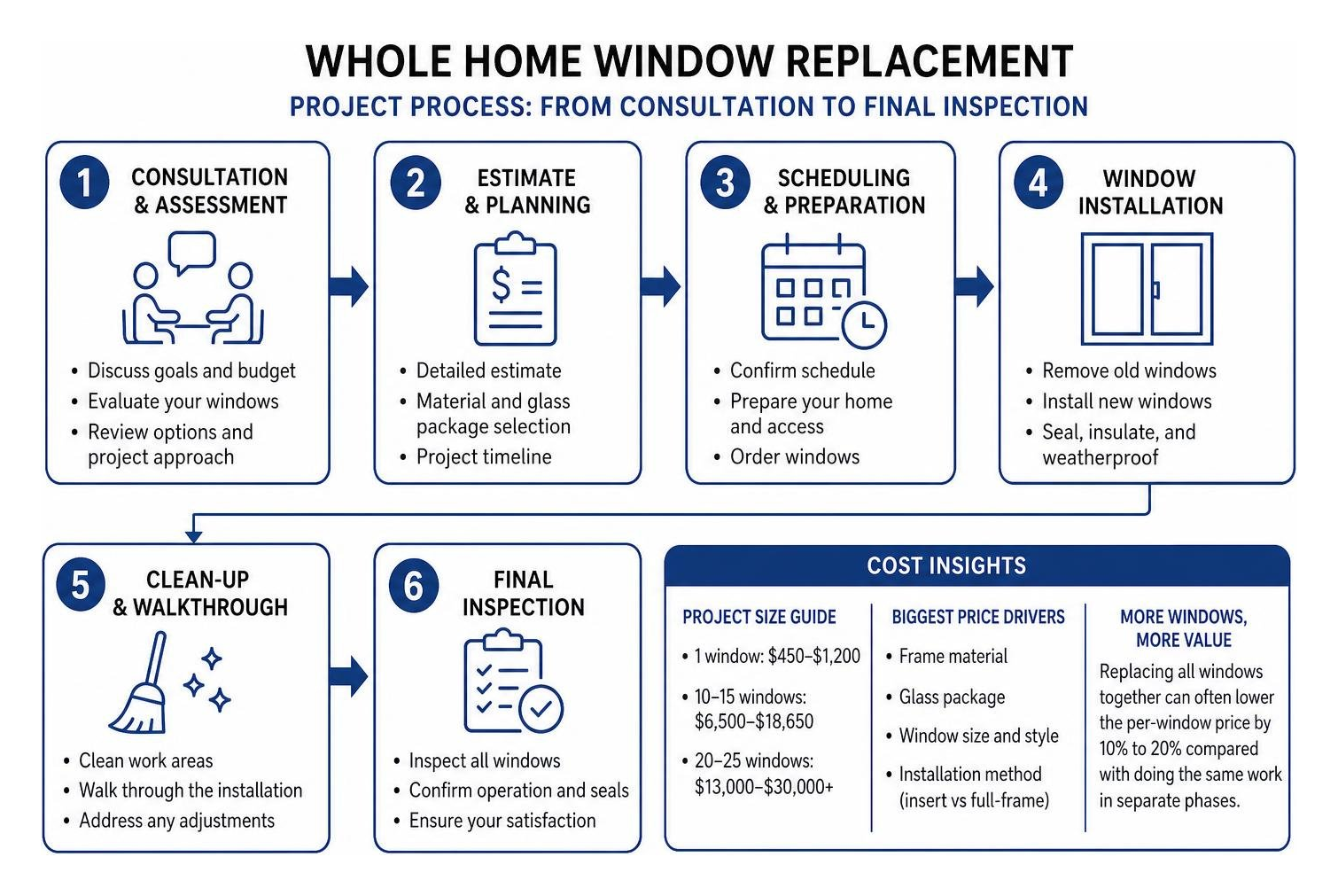
Understanding What you need to know before getting new windows includes accounting for physical obstacles. Second-story openings require ladder staging or scaffolding, adding $400 to $1,600 to total labor. However, higher volume allows installation crews to streamline framing prep, weatherproofing, and interior finish work, driving down per-unit labor overhead.
Key Factors That Impact Window Replacement Pricing
Four primary variables dictate your overall window investment: frame material, glazing package, installation approach, and permitting.
How Material Choice Influences the Cost to Replace Windows in House
Frame composition serves as the single largest material cost driver. Each option offers distinct thermal performance, structural rigidity, and architectural appeal:
| Frame Material | Typical Installed Cost (Per Window) | Expected Lifespan | Key Characteristics |
|---|---|---|---|
| Vinyl | $300 – $800 | 20 – 40 Years | Excellent insulation, low maintenance, budget-friendly |
| Thermally Improved Aluminum | $500 – $1,100 | 25 – 45 Years | Slim profiles, high structural strength, modern aesthetic |
| Fiberglass / Composite | $800 – $1,500+ | 35 – 50+ Years | Exceptional rigidity, low thermal expansion, rot-proof |
| Wood / Wood-Clad | $700 – $1,865+ | 30 – 50+ Years | Premium classic look, high insulation, requires upkeep |
When assessing options, a Detailed guide to comparing vinyl window costs demonstrates why vinyl leads the residential replacement market. For modern designs requiring narrow sightlines, Aluminum windows with thermal breaks provide enhanced strength. Homeowners seeking dimensional stability under intense solar exposure frequently turn to Fiberglass windows.
When selecting Milgard windows, reviewing warranty tiers protects your investment. Milgard features a tiered structure:
- Standard Limited Lifetime Warranty: Scope varies by new construction versus replacement and occupancy type. If transferred after sale, coverage becomes a 10-year parts-only limited warranty calculated from the manufacture date, including 10-year hardware coverage and product-specific finish/weatherstripping limitations. Specific shorter limits apply across coverage:
- 10-Year Limits: Insulated glass unit delamination, internal blind defects, and finish peeling or fading.
- 1-Year Limits: Weatherstripping, insect screens, and corrosion on stainless steel hardware.
- Paid Full Lifetime Warranty Upgrade: Valid for the natural lifetime of the original consumer owner, this upgrade is non-transferable and covers both parts and labor. It includes glass breakage coverage for Tuscany® V400 and V450 series, while requiring glass breakage as an added upgrade for Trinsic™ V300 series products.
Glass Packages, Energy Efficiency Ratings, and Regional Labor
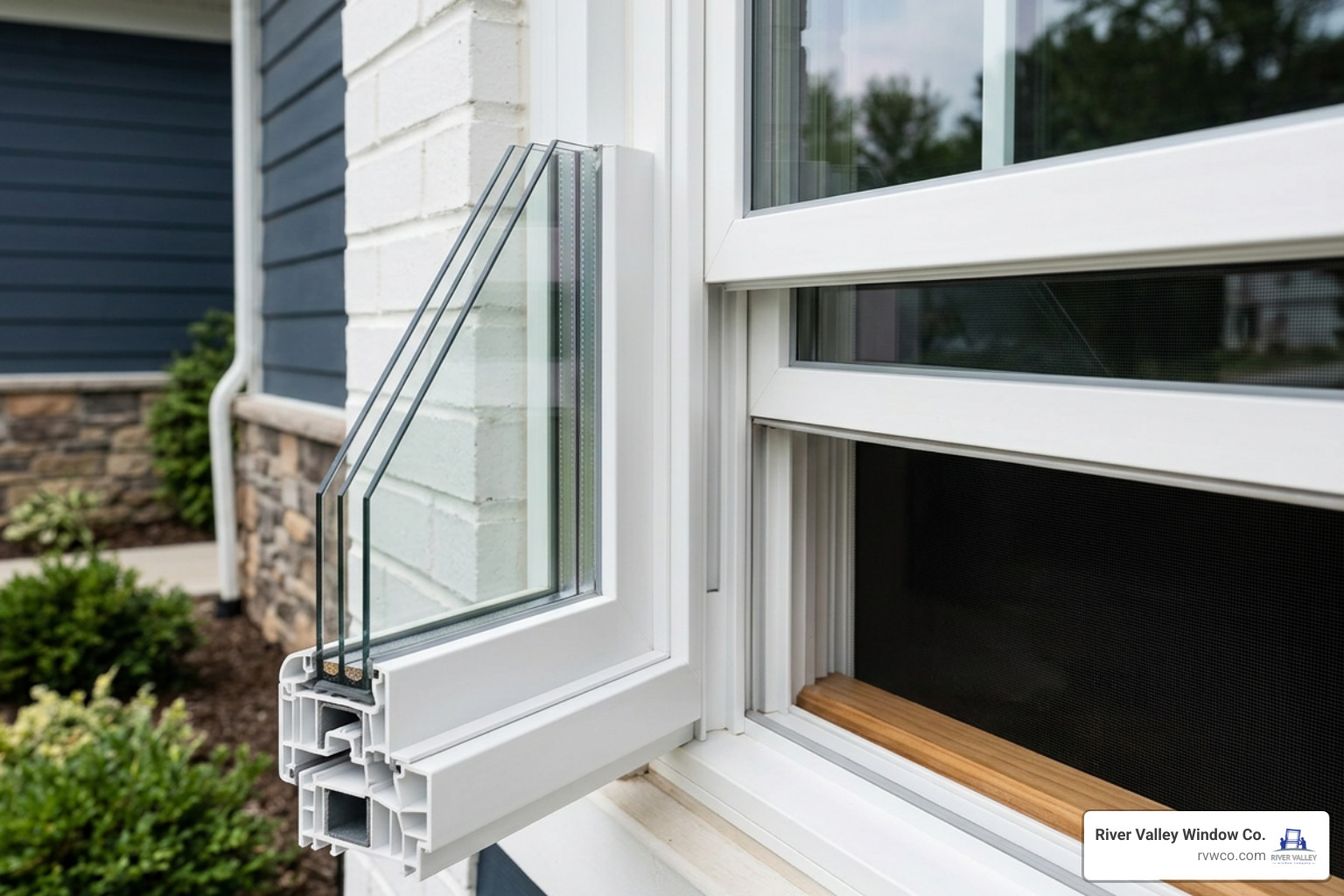
Glass configurations represent 8% to 15% of your total window investment. Standard dual-pane glass serves as the baseline, but upgrading to high-performance configurations provides noticeable thermal advantages. Investing in advanced How energy efficient windows can save you substantial money focuses on key performance metrics:
- Low-E (Low-Emissivity) Coatings: Microscopically thin metallic layers reflect radiant heat without blocking visible light.
- Argon Gas Fills: Inert gas injected between panes slows thermal conductivity compared to standard air.
- U-Factor & SHGC: Lower U-factors indicate superior insulation against heat transfer, while a low Solar Heat Gain Coefficient (SHGC) blocks intense solar radiation—critical for managing cooling demand in sunny desert climates.
Labor expenses also vary significantly based on regional wage indices. High-cost metropolitan markets can run 30% to 50% above rural and suburban baselines, directly shifting the overall quote.
Retrofit Insert Installation vs. Full-Frame Tear-Out
The chosen installation technique changes total labor hours and structural finish requirements:
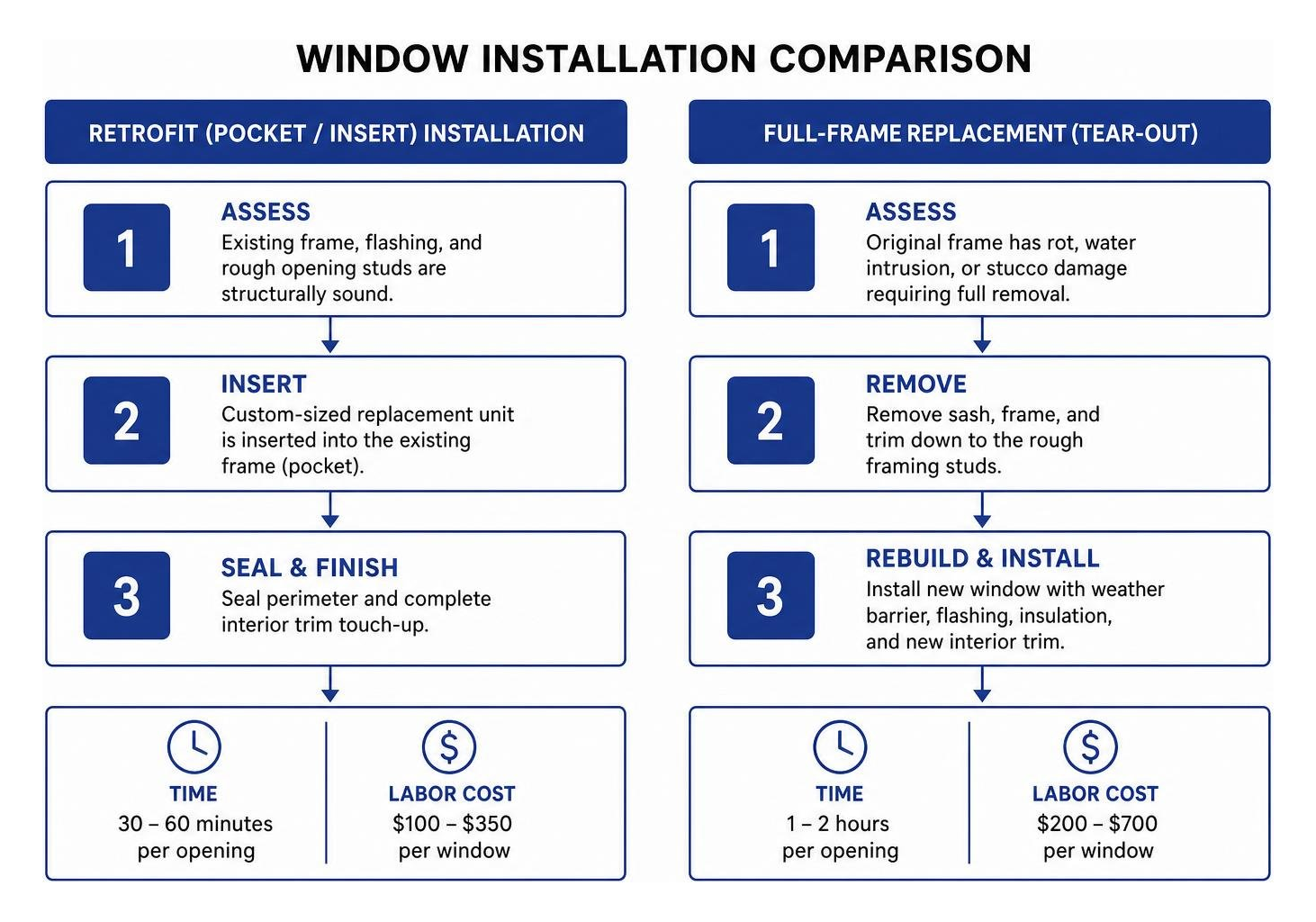
- Retrofit (Pocket / Insert) Installation: If existing window frames, flashing, and rough opening studs are structurally sound, technicians insert a custom-sized replacement unit directly into the existing frame. This approach takes 30 to 60 minutes per opening, minimizes interior trim disruption, and costs $100 to $350 in labor per window. It represents A painless guide to the best way to replace windows.
- Full-Frame Replacement: If the original frame suffers from wood rot, water intrusion, or stucco damage, crews must strip the entire assembly down to the rough framing studs. This requires new weather-resistant barrier integration, exterior flashing, and interior trim carpentry. Labor climbs to $200 to $700 per opening and takes 1 to 2 hours per unit.
Single-Project vs. Phased Window Upgrades and Financial Return
Choosing whether to upgrade all windows simultaneously or spread work over several phases involves balancing immediate cash flow against overall project savings.
Bulk Installation Economics vs. Staged Phases
Upgrading your entire home at once unlocks 10% to 20% in overall savings. Manufacturers provide volume tier discounts when ordering 8, 12, or 20+ units together. Contractors also reduce per-unit pricing because mobilization, travel, protective masking, dumpster rentals, and permitting are handled once.
Staging the project across three separate years introduces recurring setup fees and labor minimums, ultimately adding $1,400 to $2,250 to a 15-window replacement. If budget constraints necessitate staging, How to find affordable windows without sacrificing quality means prioritizing high-impact areas first:
- Phase 1: Failed seals, structural leaks, and south- or west-facing rooms enduring maximum sun.
- Phase 2: High-occupancy primary living areas and master bedrooms.
- Phase 3: Low-traffic guest rooms, basements, and shaded utility areas.
Long-Term Energy Savings, Tax Credits, and Resale ROI
Window replacement delivers strong financial returns through energy conservation and elevated home values. Exploring What kind of window offers the best ROI shows that vinyl window replacement recoups approximately 68.5% of its upfront cost at resale.
Furthermore, learning How new windows and doors can help you save on your energy bills illustrates that replacing leaky single-pane units can lower annual cooling and heating costs by 20% to 25%, saving $300 to $1,000+ per year.
Tax Status Note for 2026: The previous federal Energy Efficient Home Improvement Credit expired for installations completed after December 31, 2025. Homeowners in 2026 should focus on regional utility rebates, state energy programs, and local electrification incentives to offset installation costs.
Frequently Asked Questions About Residential Window Costs
How much does labor cost compared to materials for window replacement?
On a standard residential replacement project, costs typically break down as follows:
- Window Units (Materials): 50% to 55%
- Installation Labor: 20% to 30%
- Trim, Casing, & Finish Carpentry: 10% to 12%
- Glass Upgrades & Coatings: 5% to 8%
- Flashing, Sealants, & Disposal Fees: 4% to 5%
Base labor typically ranges from $100 to $350 per unit for insert installations and $200 to $700 per unit for full-frame tear-outs.
Are there federal tax credits or utility rebates available in 2026?
Federal tax credits under the Energy Efficient Home Improvement framework concluded at the end of 2025. However, many electric utilities and municipal energy offices offer local rebates ranging from $25 to $100 per certified ENERGY STAR® window. Check with your local power provider before finalizing product specifications.
When should failing windows be repaired instead of replaced?
Minor hardware issues, such as broken latches, stripped cranks, or worn weatherstripping, are cost-effective repairs. However, review these 3 signs it’s time for window replacement:
- Severe Frame Rot or Warping: Structural decay prevents airtight sealing and invites moisture intrusion.
- Compromised Insulated Glass Seals: Internal fogging or condensation between panes indicates seal failure and lost thermal performance.
- Excessive Drafts and Sticking Sashes: Sashes that bind, stick, or permit visible airflow point to frame shifting or hardware failure beyond simple adjustment.
If multi-pane units display widespread seal failure or frame deterioration, replacement is far more cost-effective long-term than recurring cosmetic repairs.
Conclusion
Upgrading your home’s windows enhances energy performance, eliminates drafts, and elevates interior comfort. Whether replacing a single opening or tackling a whole-home upgrade, balancing frame materials, glass performance, and non-invasive installation techniques ensures the highest return on investment.
At River Valley Window Co., we deliver fast, non-invasive installations backed by exceptional product craftsmanship. Explore our full range of professional window replacement services today to schedule your consultation and secure an accurate, transparent estimate for your home.