

Why Window Energy Savings Matter More Than You Think
Window energy savings are one of the fastest ways to cut utility bills in a typical home — but the results vary widely depending on your windows, your climate, and the products you choose.
Here’s a quick snapshot of what you need to know:
| Factor | Key Number |
|---|---|
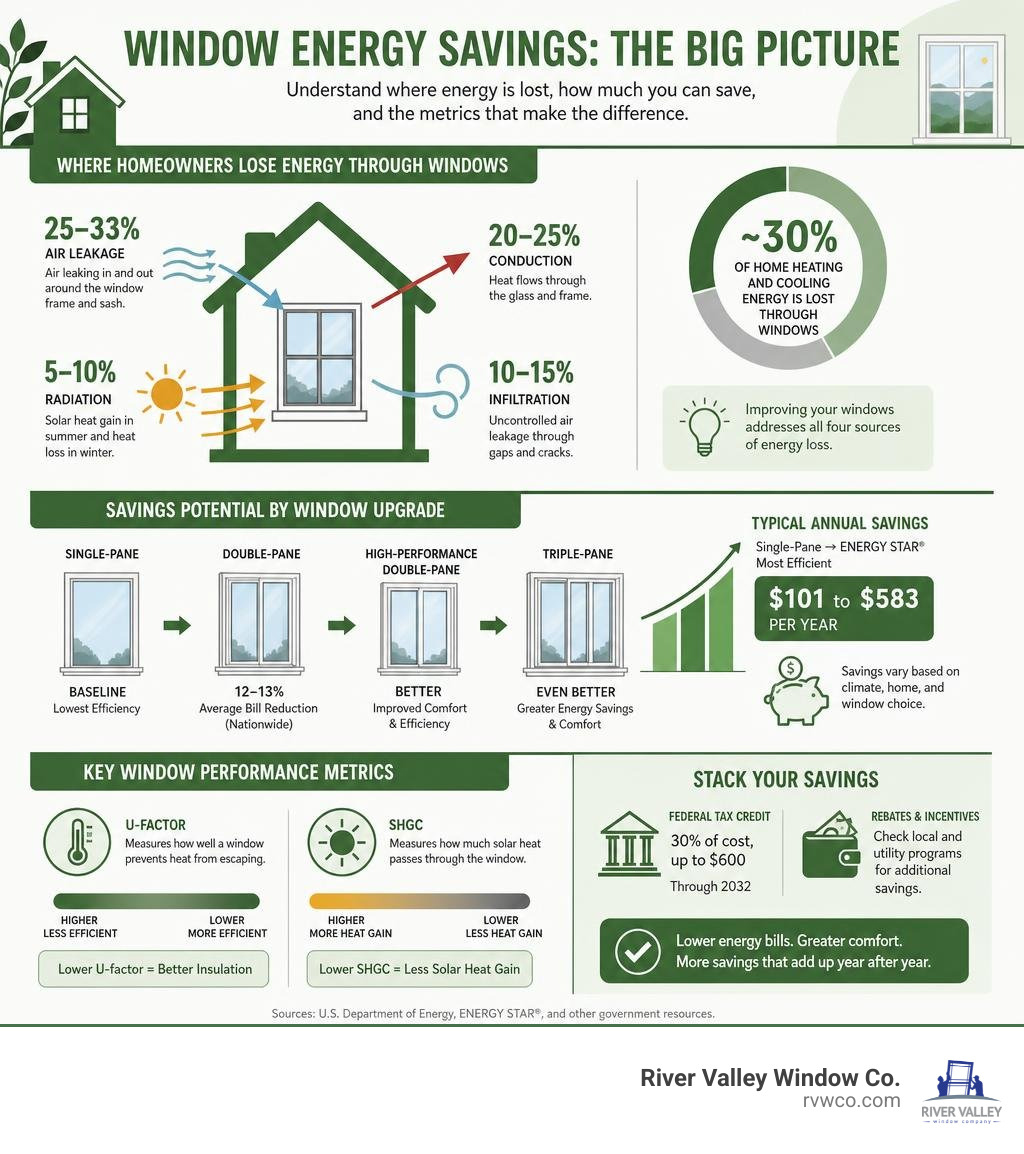
| Energy lost through windows in a typical home | ~30% of heating and cooling |
| Average bill reduction replacing single-pane windows | 12–13% nationwide |
| Typical annual savings (single-pane to ENERGY STAR Most Efficient) | $101 to $583 per year |
| Federal tax credit available (through 2032) | 30% of cost, up to $600 |
| Air leakage share of total window energy loss | 25–33% |
If you’re a homeowner in Northwestern Arizona — where summer cooling bills can be brutal — old or single-pane windows aren’t just uncomfortable. They’re expensive. Windows account for roughly 25–30% of your home’s total heating and cooling energy use, according to the U.S. Department of Energy. That means a significant chunk of your air conditioning is leaking right through your glass.
The good news? Modern energy-efficient windows have come a long way. The right upgrade can make your home noticeably more comfortable, protect your furniture from UV damage, reduce noise, and pay dividends on your energy bills for years to come.
This guide walks you through everything — from the science behind heat transfer, to the metrics that actually matter, to how to stack tax credits and rebates for maximum savings.
The Physics of Window Energy Savings
To understand how high-performance windows keep your home comfortable, we first have to look at how heat moves. Heat is restless; it always travels from a warmer space to a cooler space. In Lake Havasu City, this means blistering summer heat is constantly trying to force its way inside your air-conditioned home.
This heat transfer occurs through four primary physical mechanisms:
- Conduction: Direct heat transfer through the solid materials of the window, such as the glass and the frame. For example, a hot aluminum frame conducting heat directly to your interior drywall.
- Radiation: Radiant energy from the sun passing directly through the glass as electromagnetic waves, heating up your floors, walls, and furniture.
- Convection: The movement of air caused by temperature differences. Warm air rises and cool air falls against the glass, creating indoor drafts even when the window is completely shut.
- Air Leakage: Physical gaps, cracks, or degraded weatherstripping around the window frame that allow hot air to blow directly into your home.
In a typical home, roughly 30% of residential heating and cooling energy is lost through these pathways. In fact, air leakage alone accounts for approximately 1/4 to 1/3 of the total energy loss in older single-pane windows. By upgrading your windows, you physically block these heat transfer pathways, keeping your cooled air inside and the desert heat out.
To explore how these physical mechanisms impact your pocketbook, check out our guide on How Replacing Windows and Doors Can Save You Money.
Comparing Window Technologies and Materials
When evaluating replacement options, you will encounter several different glazing and glass technologies. Each operates differently to achieve window energy savings:
- Double-Pane Windows: The modern standard. These feature two layers of glass separated by a sealed space filled with an insulating gas.
- Triple-Pane Windows: These add a third layer of glass and a second gas-filled space. While they offer incredible insulation in freezing northern climates, they are rarely cost-effective in the hot desert of Northwestern Arizona, where double-pane windows with advanced solar control coatings provide all the heat rejection you need.
- Secondary Glazing (Storm Windows): An exterior or interior pane added over an existing window. While they offer a 20% savings alternative for historic preservation districts, they do not match the performance or convenience of a full replacement.
- Electrochromic (Smart) Windows: These use electrical currents to dynamically tint the glass based on solar intensity. While common in advanced commercial buildings, they remain highly expensive for residential use.
- Vacuum Insulated Glass (VIG): An emerging technology where the air between two panes is completely evacuated to create a vacuum. This delivers triple-pane performance in a double-pane thickness, though at a premium price point.

Understanding Single vs. Double Pane Window Energy Savings
If your home still has original single-pane windows, you are essentially living with open thermal holes in your walls. Single-pane glass has virtually zero insulating value.
Upgrading to double-pane windows is the single biggest leap in efficiency you can make. Replacing old single-pane windows with ENERGY STAR certified models lowers household energy bills by an average of 12% to 13% nationwide. In extreme climates like Northwestern Arizona, the difference is even more dramatic. Double-pane windows create a protective thermal barrier, keeping glass surface temperatures comfortable and reducing the workload on your air conditioning unit.
For a deeper dive into the exact structural differences, read our article Understanding Single vs Double Pane Windows for Your Home.
Frame Materials and Gas Fills
The glass is only part of the equation; the frame material and the invisible gas between the panes play massive roles in overall performance.
Frame materials vary widely in their thermal conductivity:
- Vinyl Frames: Vinyl is the most popular frame material in the United States, holding roughly 70% of the market share. It is highly energy-efficient, virtually maintenance-free, and offers an exceptional cost-to-performance ratio. You can learn more about how this material works to your advantage in our guide on How Vinyl Windows Enhance Energy Efficiency in Your Home.
- Fiberglass Frames: Fiberglass offers the ultimate in durability and thermal performance. It expands and contracts at nearly the exact same rate as glass, ensuring the tightest possible seals over time.
- Aluminum Frames: While structurally strong, standard aluminum is highly conductive. Without a specialized “thermal break” (an insulating plastic barrier built inside the frame), aluminum windows will transfer outdoor heat directly into your home. Discover the pros and cons of this material in our article, Are Aluminum Windows Energy Efficient.
Between those panes of glass, manufacturers seal inert, non-toxic gases to slow down heat transfer. Argon gas is the industry standard—it is denser than air, highly effective, and very affordable. Krypton gas is even denser and provides superior insulation, but it is substantially more expensive and typically reserved for narrow-profile triple-pane units. Over time, high-quality insulated glass units (IGUs) lose gas at a very slow rate of about 1% per year, maintaining their efficiency for decades.
Climate-Specific Selection and Performance Metrics
When shopping for windows, you must look past marketing buzzwords and check the official National Fenestration Rating Council (NFRC) label. This label is the only way to verify performance and ensure you are buying What Are Energy Star Windows for your specific region.
The International Energy Conservation Code (IECC) divides the country into distinct climate zones. Because a window designed to keep heat in during a Minnesota winter is built differently than a window designed to keep heat out during an Arizona summer, your local climate dictates your ideal window specifications.
| Climate Zone | Primary Goal | Recommended U-Factor | Recommended SHGC |
|---|---|---|---|
| Northern (Zones 5-8) | Keep Heat In | $\le$ 0.27 | High (Allows passive solar heat) |
| North-Central (Zone 4) | Balanced | $\le$ 0.28 | Moderate |
| South-Central (Zone 3) | Cooling Dominated | $\le$ 0.30 | $\le$ 0.25 |
| Southern (Zones 1-2, including AZ) | Block Solar Heat | $\le$ 0.40 | $\le$ 0.25 |
Maximizing Window Energy Savings in Hot Desert Climates
In Northwestern Arizona, particularly in Lake Havasu City, we live in a cooling-dominated climate. Our primary energy expense is air conditioning. Therefore, maximizing window energy savings in our region requires a heavy focus on solar control.
To achieve this, high-performance windows utilize microscopically thin metal oxide layers called Low-E (low-emissivity) coatings. In hot desert climates, we apply a solar control Low-E coating specifically to Surface 2 (the inner surface of the exterior pane). This reflects solar infrared heat back outside before it can even cross the air gap into your home.
Combining these coatings with high-performance framing is the ultimate way to lower cooling costs. Find out more about selecting local options in our article How New Windows and Doors Can Help You Save on Your Energy Bills.
U-Factor vs. SHGC
To compare window efficiency accurately, you must understand the four key metrics listed on every NFRC label:
- U-Factor: Measures the rate of non-solar heat transfer (insulating power). Ratings typically range from 0.10 to 1.20. Lower numbers mean better insulation. In the desert, a low U-factor prevents hot summer air from heating up your cool indoor air.
- Solar Heat Gain Coefficient (SHGC): Measures how much solar radiation passes through the window. Ratings range from 0 to 1. In Northwestern Arizona, SHGC is the most critical metric. You should look for an SHGC of 0.25 or lower to block the intense desert sun.
- Visible Transmittance (VT): Measures the amount of daylight that passes through the window. It ranges from 0 to 1. A higher VT means more natural light, while a lower VT acts like sunglasses for your home.
- Condensation Resistance (CR): Measures how well the window resists moisture buildup on the inside surface. Ratings range from 1 to 100, where higher numbers are better.
Financial Incentives, Tax Credits, and ROI in 2026
Upgrading your windows is a significant investment, but in July 2026, there are more financial tools than ever to help offset the upfront cost.
Under the federal IRS Section 25C (Energy Efficient Home Improvement Credit), homeowners can claim a tax credit of 30% of the product cost, up to $600 per year for windows that meet the strict “ENERGY STAR Most Efficient” criteria. If you are also replacing exterior doors, you can claim an additional 30% up to $500.
Because these annual limits reset every calendar year, some homeowners choose to split their window replacement project across multiple years to maximize their tax savings. When filing your taxes, the IRS requires a Qualified Manufacturer ID (QMID). For example, if you install qualifying Milgard windows, you will use the Milgard QMID: G9L4 on IRS Form 5695.
Beyond tax credits, upgrading your windows delivers a multi-layered return on investment (ROI):
- Immediate Utility Savings: You will see a drop in your monthly electric bill right away.
- HVAC Downsizing: High-performance windows reduce your home’s peak thermal load. When it comes time to replace your air conditioner, you can often install a smaller, less expensive system because your home doesn’t require as much cooling power.
- Property Value: New energy-efficient windows typically increase a home’s resale value by 3% to 5%.
To see how these savings compare to other home improvements, check out our guide on What Kind of Window Offers the Best ROI.
Frequently Asked Questions about Window Efficiency
How much can I save on my energy bills with ENERGY STAR windows?
Nationwide, homeowners save an average of 12% to 13% on their energy bills. According to regional data, replacing single-pane windows with ENERGY STAR Most Efficient certified models typically saves homeowners between $101 and $583 per year. In Lake Havasu City, where summer electric bills can skyrocket, your actual savings may sit at the higher end of that spectrum.
For a detailed breakdown of how these savings compound over time, read How Energy Efficient Windows Can Save You Substantial Money.
Why is professional window installation recommended?
Even the most advanced, expensive window on the market will fail if it is installed incorrectly. Professional installation is critical for several reasons:
- Air and Water Sealing: Professionals apply specialized flashing and sealants to prevent air leakage and protect against water intrusion during heavy monsoon storms.
- Warranty Protection: Many window manufacturers will void their product warranties if the window is damaged or performs poorly due to improper DIY installation.
- Structural Alignment: Desert homes settle, and frames must be perfectly square and level to ensure smooth operation and tight seals.
To learn more about identifying failing seals and leaks in your current setup, read 3 Signs Your Patio Door Isn’t Energy Efficient.
What are the current Milgard warranty options?
Milgard is famous for its robust warranty protection, which is structured to give homeowners total peace of mind. They offer two primary warranty paths:
- Standard Limited Lifetime Warranty: This warranty varies depending on whether the project is new construction or replacement, and the occupancy of the building. If you sell your home, the warranty can be transferred to the next owner. Once transferred, it becomes a 10-year parts-only limited warranty calculated from the original manufacture date, including 10-year hardware coverage and specific limitations on finishes and weatherstripping.
- Full Lifetime Warranty Upgrade: This paid upgrade is valid for the natural lifetime of the original consumer owner and is non-transferable. It covers both parts and labor. Notably, it includes glass breakage coverage for the Tuscany® V400 and Tuscany® V450 series. For the sleek, modern Trinsic™ V300 series, glass breakage coverage is available as an added upgrade.
That shorter limits apply to specific components under both warranties:
- 10-Year Limits: Insulated glass unit (IGU) delamination, internal blind defects, and peeling or fading on exterior finishes.
- 1-Year Limits: Weatherstripping, screens, and corrosion on stainless steel hardware.
Conclusion
Maximizing your window energy savings isn’t just about picking a window off a shelf. It requires choosing the right materials, the perfect climate-specific glass coatings, and ensuring a flawless installation.
At River Valley Window Co., we specialize in helping homeowners throughout Lake Havasu City and Northwestern Arizona navigate these choices. We proudly offer high-performance Milgard vinyl and fiberglass products tailored specifically to withstand our intense desert heat.
Our unique signature is our fast, non-invasive installation process, which allows us to upgrade your home’s comfort and efficiency with minimal disruption to your daily life. Backed by Milgard’s industry-leading lifetime warranties and our own dedication to quality, we make sure your investment is protected for the long haul.
Ready to start saving? Explore your options by visiting Energy Efficiency and Your Local Window Replacement Options or contact our team today to schedule your consultation.